|
VOICES
OF THE 1940s
George
A. Hartrick, program director
Frank J. Abbott
Charles R. LaFlamme
Robert S. Findlay
John F. Adams
Robert A. Athearn
Norman E. Bailey
Gene Newcomb
John Gerald Kearney
Chuck O'Neil
Frederick W. Cole, program manager
George Christie, The Old Crusader
Francis J. Baroody
Warren H. Journay, program manager
Frank J. Finning
Dick Lance
Raphael E. Sjoberg
Janet J. Carr
Adeline Casseboom
Armand R. LaPointe, Jr.
Alphonse Maffie
Bill Sullivan
|
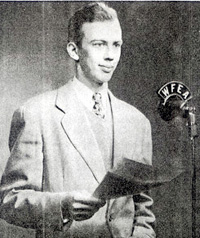 |
| Ray
Sjoberg hosted Dance Time and sometimes flipped hot platters
on the 1370 Streamliner |
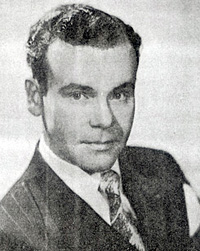 |
| Every
Wednesday night at 7:45, vocalist Gene Newcomb sang the favorite songs
of the day on Serenade in the Evening |
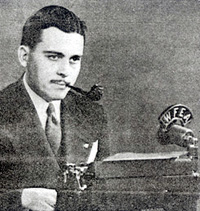 |
| Armand
LaPointe was WFEA's first news editor, delivering five daily newscasts
Monday through Saturday |
 |
|
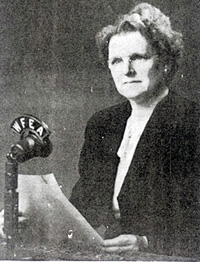
Home economist Adeline Casseboom hosted Kitchen Chat weekday
mornings at 10, sponsored by the Manchester Gas Company |
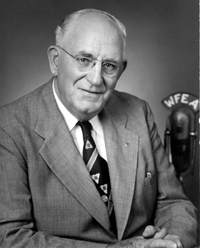 |
| A
fine boxing and greyhound dog race announcer, George Christie earned
his nickname as The Old Crusader by his pointed editorials
on Manchester matters |
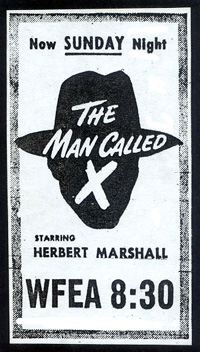 |
| Newspaper
ad - November 2, 1947 |
|
|
|
The year 1941 proved eventful
for Manchester's first radio station. It became a member of the
NBC Basic Red Network.
On March 29, 1941, WFEA
changed its frequency for the third and final time. At three o'clock
in the morning, the North American Regional Broadcast Agreement
(NARBA) went into effect to ease overcrowding on the AM band. All
stations operating at a frequency higher than 740 kilocycles moved
to new dial positions; WFEA moved to 1370.
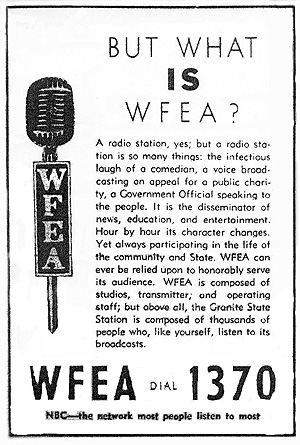
On December 19, 1941, WFEA
was granted permission to increase its power output to 5,000 watts.
|
 |
|
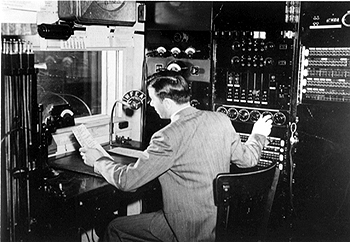
WFEA engineer Claude
Marquis in May 1943
|
|
On November 28, 1944 the
FCC approved the sale of WFEA to Pittsburgh Sun-Telegraph publisher
Harry M. Bitner for $150,000. Bitner assumed control on December
15th; Melvin C. Green was appointed general manager. The following
May, New Hampshire Broadcasting Company also sold WFEA's Merrimack
transmitter building, towers, and 20 acres of land to Bitner.
In June, 1945, the station
said goodbye to NBC and reaffiliated with CBS, while maintaining
the Yankee Network affiliation. On October 5th Bitner applied for
an FM license, a story that would play out unsuccessfully three
years later.
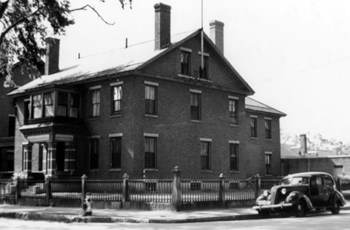
The new year 1946 meant
a new home. On January 27, WFEA moved its studios across the street
from the Carpenter Hotel to a former private home at 287 Franklin
Street.
|
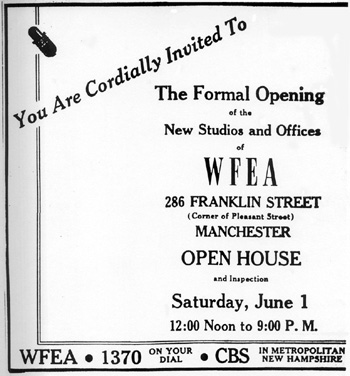
| An open house
was held on June 1, 1946. |
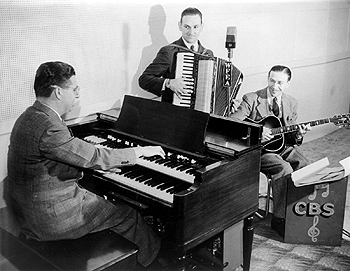 |
An
in-house group, The WFEA Trio, performed live music every weekday
on Your Luncheon Serenade and Your Dinner Serenade.
The group consisted of keyboard player Roger Barrette, accordionist
Ernie Woessner and
guitarist Gerry Kearney.
|
In January, 1947 WFEA and WMUR
(610kc, now WGIR AM) announced joint plans to enter the emerging frequency
modulation market by applying for FM licenses. Their plan was to jointly
operate from one building atop the 1,329-foot Mount Uncanoonuc in Goffstown,
NH.
WFEA was awarded a conditional
grant for WVMA FM (101.1kc, 3.4kw) in October, but in February, 1948 licensee
Harry M. Bitner sold the stations to N.H. Broadcasting Company, Inc.,
and the construction permit for WVMA FM expired in September (WMUR was
more successful and today WGIR FM operates from Mount Uncanoonuc on 101.1mc).
Bitner owned WFEA for just over
three years when he sold to N.H. Broadcasting, Inc. for $186,661. The
principals were brothers Henry and Morris Silver, owners of a successful
Manchester bottling company and beverage distribution business, and Samuel
G. Camaan, owner of Pariseau's Department Store. They installed Arthur
I. "Roxy" Rothafel as station manager.
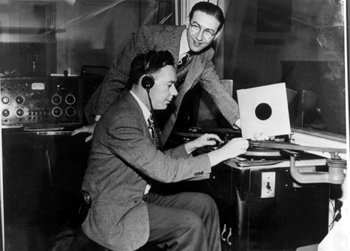
When
WFEA wasn't carrying network programs or featuring live
entertainment, disc jockeys like Chuck O'Neil and Gerry Kearney played
popular music from large discs known as electrical transcriptions.
|